Insights
Do AI podcast voices still sound robotic?
AI voices used to sound like Speak & Spell. A decade of neural synthesis changed that. Listen to a real sample episode and judge for yourself.
You picture the voice already, flat and monotone, turning "markets rallied on soft inflation data" into a hostage negotiation. It is a fair worry. Audio you cannot stand for five minutes will not help you stay informed.
So here is my offer: do not take my word for it. Press play on the sample below, then read on.
The short answer
No, the robot voice era ended about a decade ago. In Harkwire episodes, two AI hosts, Alex and Sam, talk through your newsletters like people on a morning radio show. The sample below was made the same way as a daily episode, so you can hear the current voices directly.
A very short history of the robot voice
In 1961, a Bell Labs physicist named John Larry Kelly Jr. programmed an IBM 704 to synthesize speech. With musical accompaniment from electronic music pioneer Max Mathews, the computer sang "Daisy Bell." Arthur C. Clarke happened to be in the room, and the scene later became HAL 9000's dying song in 2001: A Space Odyssey. The voice was robotic from birth.
It stayed that way for decades. Formant synthesis built speech from tuned resonant frequencies and stayed mainstream until the mid-1990s. Results stayed recognizably robot-like into the 2000s. For most of computing history, text-to-speech meant intelligible but mechanical.
In 1984, MIT engineer Dennis Klatt's DECtalk synthesizer gave the world "Perfect Paul," the voice that became Stephen Hawking's. Hawking was offered newer, more natural voices in later years and kept the robotic one. It had become his. The most famous computer voice in history was the sound of an era.
That is the voice most people still picture, and it belongs to another era.
The year the voices changed
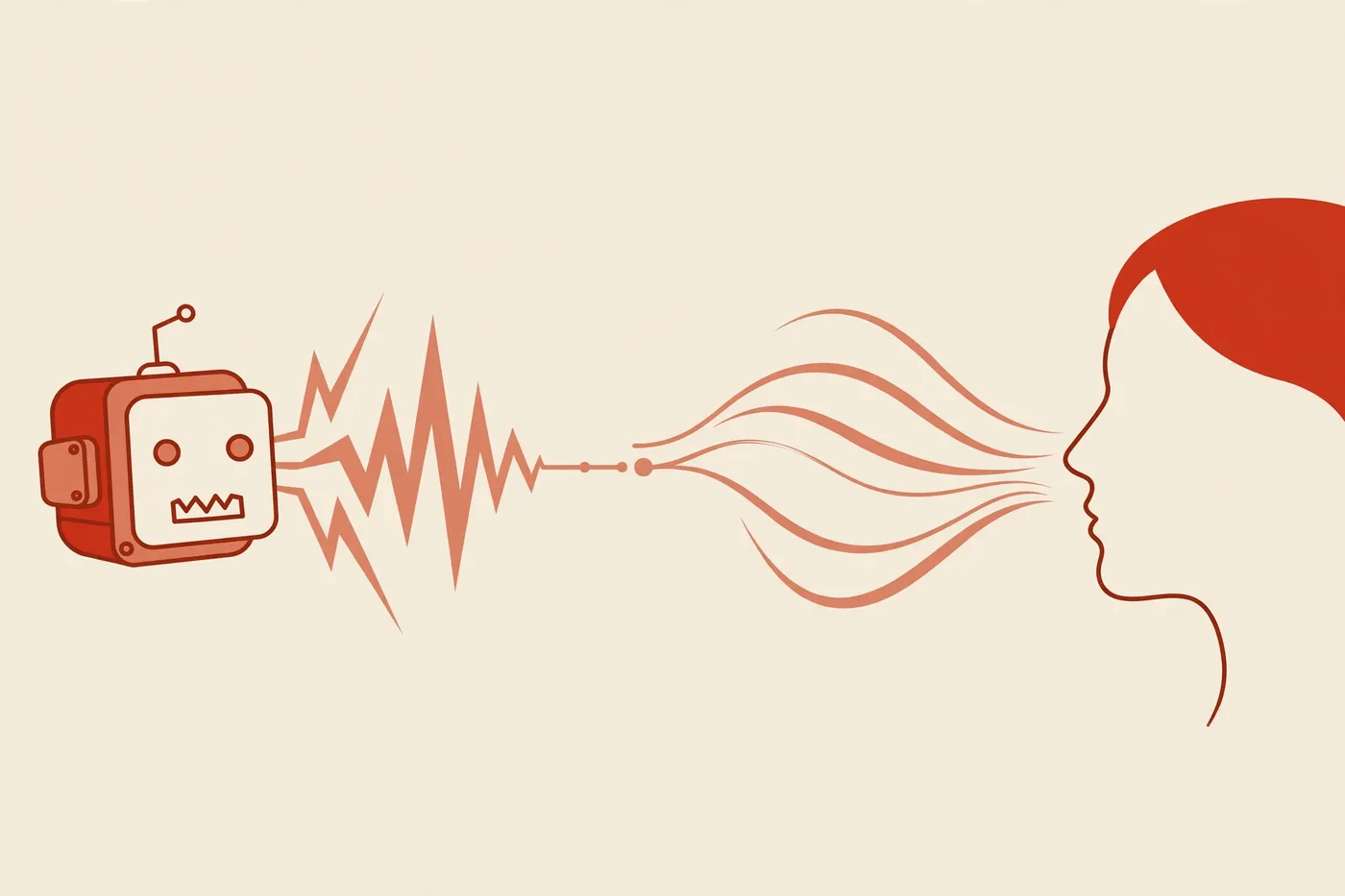
In September 2016, DeepMind published WaveNet, a neural network that generated the raw audio waveform itself, sample by sample, about 16,000 samples per second. Human listeners rated it significantly more natural than the best existing parametric and concatenative systems, in both English and Mandarin.
That was ten years ago. Since then, neural voices moved from research demos into phones, audiobooks, and podcasts. The old staccato cadence, misplaced emphasis, and dead air between words came from how the sound was made, and the making changed.
The test is a morning with coffee. Can you keep listening without thinking about the voice? Neural voices now pass that test often enough to carry a daily newsletter podcast.
The only test that works
You cannot judge a voice from adjectives, any more than you can judge a radio station by its logo.
The Harkwire sample above is five minutes with two hosts summarizing newsletters the way yours would be.
An independent check helps here, because you should not take the founder's word alone. This video runs five current AI voices through the exact same sentences and leaves the verdict to your ears, with the creator's own caveat that the machine-generated scores are only rough guesses.
Listen for three things: emphasis on the right words, pauses that feel like breathing rather than buffering, and whether you notice the conversation before the voices. If you catch yourself agreeing with a take halfway through, the test is over.
If those voices still sound like 1984 to you, say so. My bet is they do not.
Why two hosts instead of one reader
Conversation changes the listening. A single voice reading headlines can still feel like a read-aloud app. Two hosts talking through the news give your brain a conversation to follow, so the voice check fades and the stories take over.
Three honest limits from me as founder. Paid newsletters are not supported yet. Harkwire takes newsletters only, so web links and PDFs are out. The private feed works in Apple Podcasts, Overcast, and Pocket Casts, but not Spotify, which does not let you add a show by URL. The setup details are in the guide to turning your newsletter pile into a daily podcast.
- Price. From $4.99 USD per month (Starter, up to 5 newsletters), after a 7-day free trial.
- Signup. Requires a Google account.
- Lengths. Brief (1-3 min), Morning Update (3-6 min), Deep Dive (6-12 min, Pro only). The episode lands in your private feed by 7am in your timezone.
Keep the skepticism. The voices either fade behind the stories during that five-minute sample or they do not. For a morning routine, trust that listening check.