Insights
What actually happens to your newsletters when you forward them to an app
Forwarding your newsletters to a private address sounds risky. Here is what Harkwire sees, what it never touches, and what happens to the text.
Here is a small confession. Every few months I did the same thing you probably do. I looked at my inbox, saw 200 unread newsletters, felt a wave of guilt, and hit mark-all-as-read. The guilt pile did not shrink. It just went invisible.
Forwarding your newsletters to an app is the part of Harkwire people ask me about most, so here is what actually happens to them.
The short answer
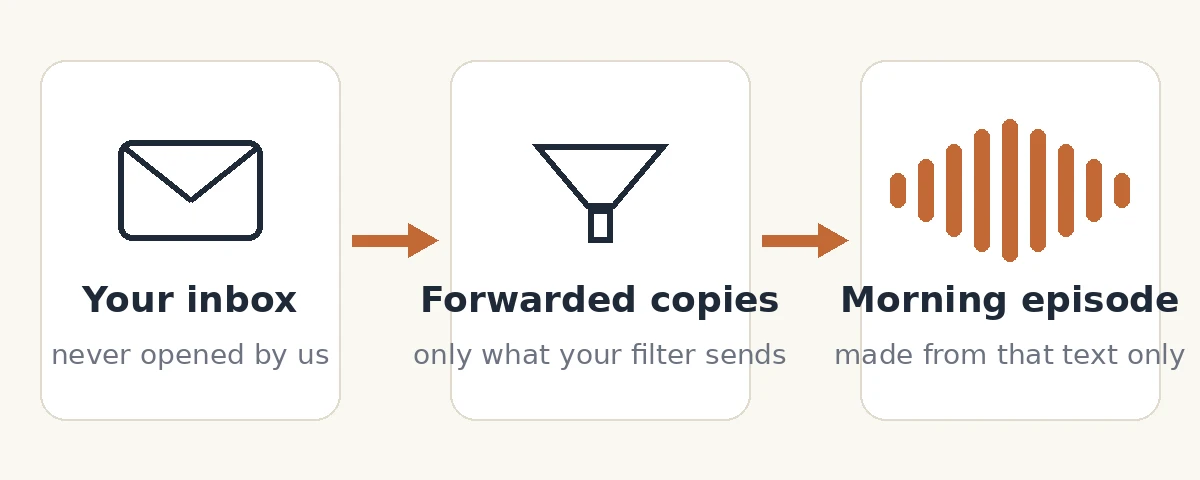
When you forward a newsletter to Harkwire, your email provider sends a copy to a private address that only you have. The forwarded emails are stored so we can make your episodes from them: we extract the text and send it to the AI models that write and record your episode. We never request access to your inbox, and we only ever see the newsletters you explicitly route to us.
Why forwarding is not the same as inbox access
Most email apps ask for inbox access at signup. From that point on they can read whatever they want: convenient, and a blank check.
Harkwire works in reverse:
- No inbox access, ever: we do not request it. Our privacy page says it plainly: we do not request access to your email account, and your inbox stays private.
- You control the routing: the only messages we ever see are the ones you explicitly route to us. Set up a filter for your newsletters and only those go. Stop the filter and nothing arrives.
- It is a one-way street: a forwarding address can receive email. It cannot browse your inbox, search old messages, or read anything you did not send it.
What happens to one forwarded newsletter, step by step
- You set up a forward rule, once. In Gmail you add your private Harkwire address as a forwarding address, then create a filter so newsletters from your chosen senders go there. Your copy stays in your inbox; a copy travels to us. Google's official instructions walk through the exact clicks.
- The copy lands at your unique address. Harkwire issues you a private forwarding address when you sign up. Only you have it.
- We extract the text and send it to the AI. Only the extracted newsletter text goes to our language-model providers for summarization. No email addresses, no headers, no metadata. The summaries then go to our text-to-speech providers to generate the audio.
- Your episode is written and recorded. Ahead of your episode, everything that arrived gets read, the strongest stories get picked, and Alex and Sam talk it through as your morning episode.
- The emails are stored; the audio is deleted after 15 days. Your forwarded emails are stored so we can make your episodes from them, then deleted after one year. The finished audio is served only to you through your private feed and deleted after 15 days.
The honest limits
A privacy explainer that only lists the good parts is a sales pitch. So here is what I will not claim.
- Signup requires a Google account. We use Google sign-in because it is simple, but it means handing identity to Google for a product that markets inbox privacy. What Google gives us is identity only: your name and email address, used to identify your account. Sign-in only; we do not access Gmail. Our privacy page says the same thing.
- Your newsletter text goes to third-party AI providers. The text goes to our language-model and text-to-speech providers, some of them outside the European Economic Area. We do not sell your data, use it for advertising, or train models on it. But if your bar is "never leaves our servers," this is not that.
- Playback analytics are on by default. When you press play, pause, or finish an episode in the web player, we record the event to learn which editions land. You can turn it off in settings any time, and we never share these events with anyone. Default-on is a choice, and now you know about it.
- Episodes are kept for 15 days. The audio is stored for 15 days, served only to you via your private feed, then deleted. Delete your account and everything goes with it: account, episodes, newsletter list, forwarding address.
Why this matters for your mornings
I am explaining this instead of just saying "trust us" because the guilt pile only dies if your newsletters actually flow somewhere. If you do not trust the routing, you will not set up the filter, and the pile wins again.
The forwarding model exists to make that decision small. One filter, one time. After that, every newsletter you care about shows up in your morning episode, in your private feed by 7am in your timezone, and your inbox stays exactly as it was. I wrote the full walkthrough of turning the pile into a daily listen in how to listen to your newsletters as a daily podcast; this privacy design is what makes that walkthrough safe to follow.
Set up the filter once. Tomorrow morning the pile is a podcast, and your inbox never noticed a thing.